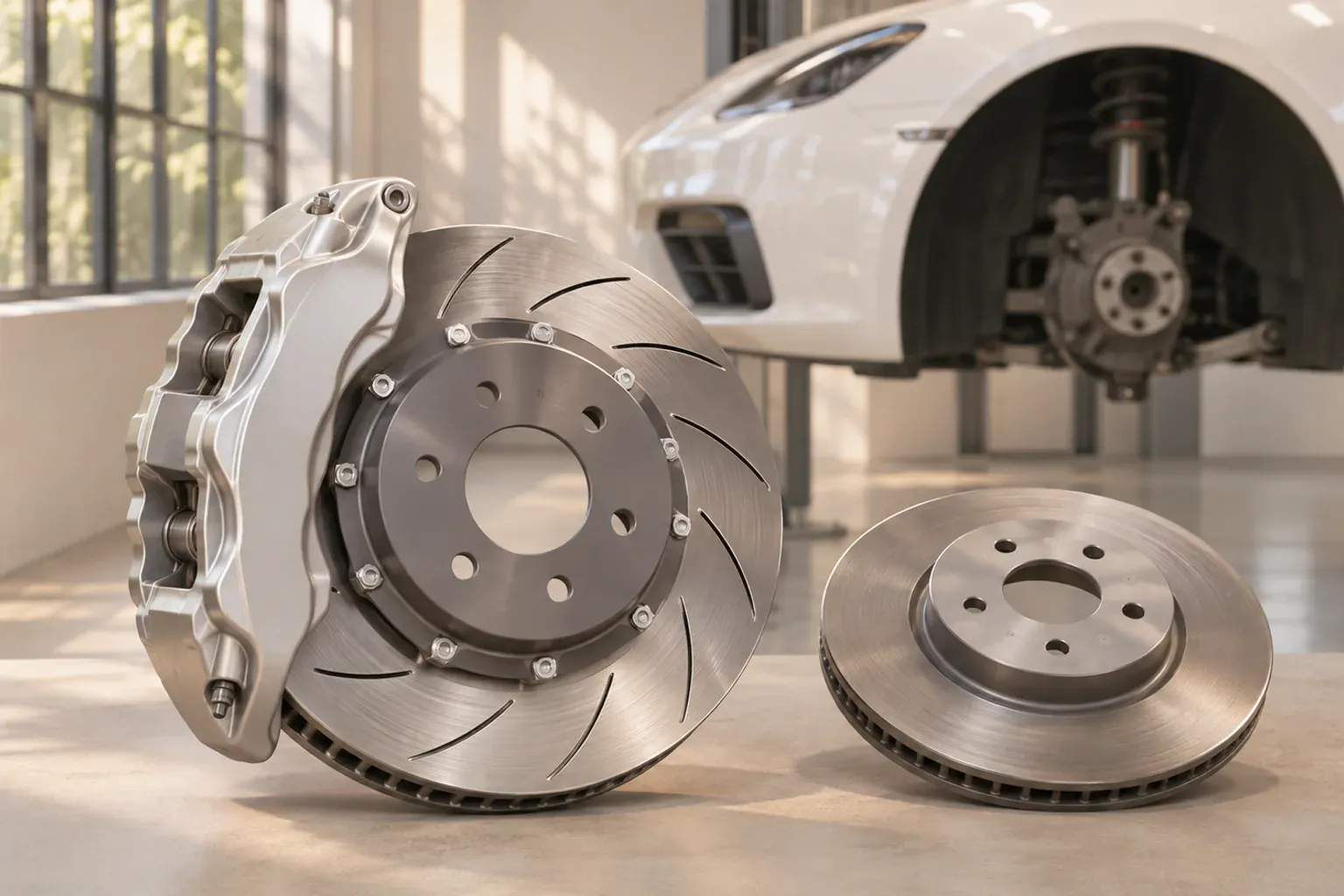
Big brake kit:when is it really useful on a sports car, and how to choose one (road and track)?
- 12 min read
Bigger brakes don't stop shorter once: they stop as well on lap ten as on lap one. Our Signes workshop's decision guide, 700 m from Circuit Paul Ricard.
A big brake kit mainly adds thermal mass: consistent pedal and less fade over track sessions. It does not shorten a single stop, which is limited by the tyre. On the road, pads, fluid and braided lines are often enough; the kit makes sense for regular track use or a heavily tuned car, with wheel fitment, balance and cooling checked.
What exactly is a big brake kit?
A coherent set of parts replacing the stock front brakes.
What's in the kit
- Multi-piston calipers
- Stiffer, more even pad pressure.
- Larger two-piece discs
- More thermal mass, free expansion on an alloy bell.
- Pads, braided lines, brackets
- Matched compound, firmer pedal, precise alignment.
Two-piece discs save weight and limit warping.
Versus simply changing pads or discs
Better pads or discs work within the stock thermal envelope.
A big brake kit enlarges that envelope, with consequences on wheels, balance and electronics.
This is the core of our high-performance brakingapproach: real use first.
What bigger brakes improve… and what they don't
“Bigger brakes stop shorter” is a myth worth unpacking.
Thermal mass and heat resistance
More material absorbs more energy before fading.
The benefit is endurance, session after session.
Single-stop distance is tyre-limited
Most stock brakes already reach the grip limit.
To stop shorter once, work on tyres and chassis.
Pedal feel, consistency and fade
A firmer, shorter, easier-to-modulate pedal.
And it stays the same when hot.
A big brake kit lets you brake as hard on the twentieth stop as on the first. Without repeated hard stops, the gain is small.
Why brakes get so hot on track
On the road, hard stops are spaced out and brakes recover.
On track, heat builds up lap after lap with no recovery phase.
A 20-minute session at Paul Ricard
- 01
Mistral straight
Highest speed of the lap, maximum energy to shed.
- 02
Heavy braking
A huge amount of heat goes into the front discs in seconds.
- 03
End of session
Undersized brakes fade; a matched system stays consistent.
A big brake kit changes nothing on lap one, everything on lap ten.
More power means higher speeds and more energy per stop. See the difference between stage 1, 2 and 3.
Signs stock brakes are reaching their limit
Saturated brakes almost always warn you first.
Long pedal
Fluid approaching boiling point.
Smell and vibrations
Pads beyond their range, uneven deposits.
Blued or cracked discs
Repeated excessive temperatures.
Old fluid or road pads on track cause the same symptoms: diagnose first.
Road, occasional track days or regular track use: what do you need?
Use, not looks or headline power, drives the decision.
 Fast road
Pads, fluid and lines are often enough
A big brake kit is usually unnecessary on the road.
 Occasional track days
Upgrade the stock system, then observe
Go further only if the pedal still fades.
 Intensive track or stage 2
The kit makes sense
With proper cooling, it brings the missing consistency.
See our track preparation and our track day preparation .
Choosing the right kit
The right kit fits the car, wheels, use and electronics.
- 01
Wheel fitment
Diameter, offset and spoke design: check with the real wheel.
- 02
Front/rear balance, ABS and ESP
Keep the overall balance the electronics were calibrated for.
- 03
Discs, pads, fluid and bedding-in
Slotted or plain for track, matched pads, fresh fluid, proper bedding.
Brakes work with the chassis: see our coilovers article and our chassis preparation.
Brake cooling: the forgotten part of kits
Stored heat must be evacuated, or the system saturates later.
Better cooling alone sometimes fixes track-day fade.
- ▸ Ducts and scoops
- Air to the centre of the vented disc.
- ▸ High-temp fluid
- Higher boiling point, renewed often.
See our guide to preparing for a track day at Le Castellet.
Homologation, roadworthiness test and insurance
Brakes are a safety system; modifications may have regulatory consequences.
Inspection checks braking; declare modifications to your insurer.
Each case depends on the parts and their documentation.
Hugues uses his stage 2 GT-R R35 daily and on track.
Big Brake Kit, alignment, cooling and engine management were treated as a whole.
Goal: a car that stays composed after back-to-back sessions.
Big brake kit FAQ
Do all four wheels need upgrading?
Not necessarily, but front/rear balance must stay consistent.
Does a big brake kit shorten stopping distance?
Rarely on a single stop: the tyre is the limit.
Which wheels are compatible?
It depends on diameter, offset and spokes: check before buying.
Maintenance between track days?
Check pads, discs, fluid and lines; bleed if the pedal got long.
Should the fluid be changed too?
Yes, fresh high-temperature fluid is essential.
Paul Ricard on day one with a new kit?
Yes, once bedded in, building pace progressively.
Size your brakes right, don't oversize them
A big brake kit solves heat-related fade, not everything.
At our Signes workshop, 700 m from Circuit Paul Ricard, we assess your brakes and use first.
Have your brakes assessed
Call, text or WhatsApp to book.
Further reading
Related services and articles.
A project,
a call.
Tell us about your car and how you use it. We'll figure out the right service together, maintenance, engine tuning, chassis, restoration.
83870 Signes
Across from the Paul Ricard circuit
Monday, Friday · 9:30-18:00
By appointment only