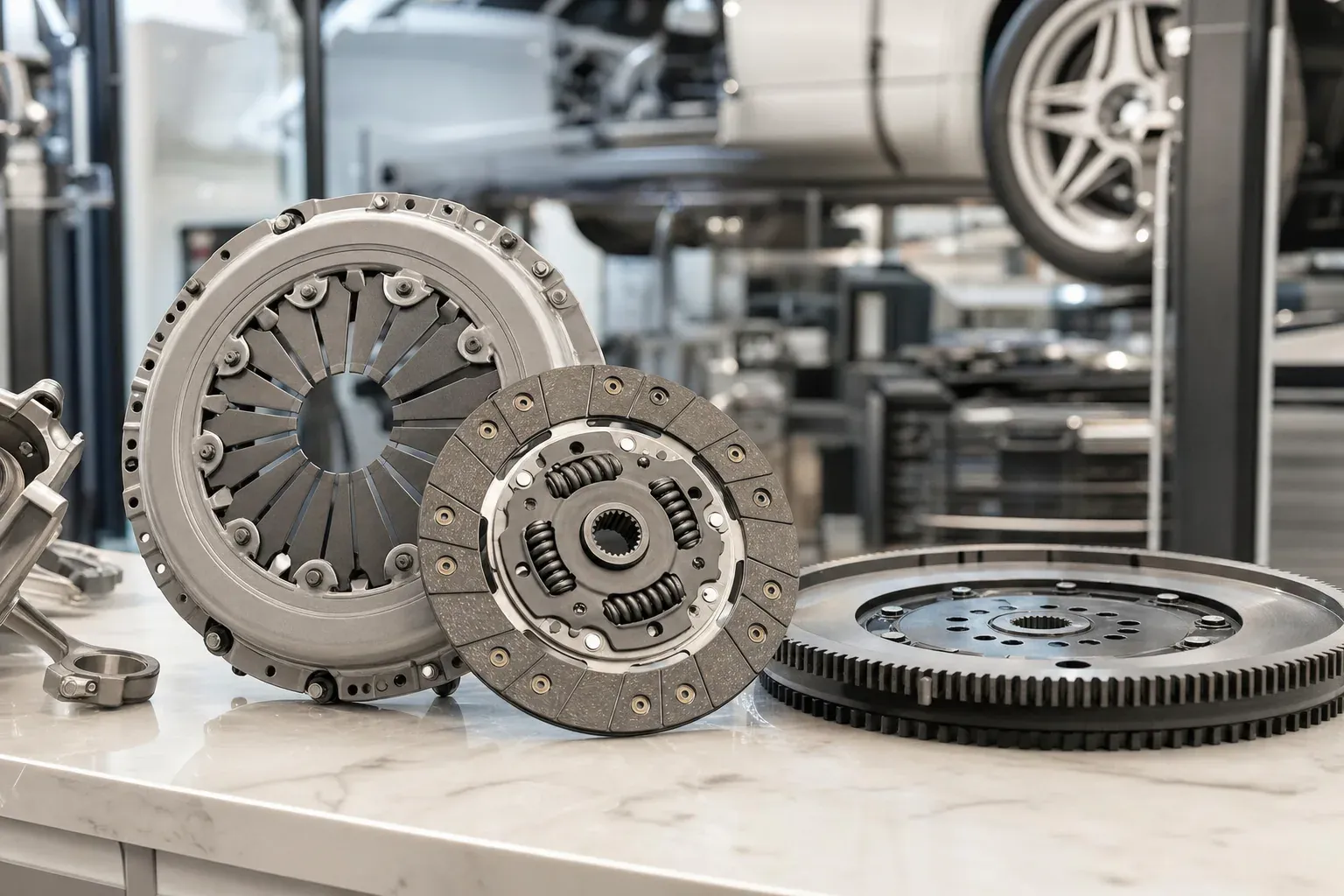
Uprated clutch:when does it become essential after a remap (stage 2, track)?
- 11 min read
More torque means more load between engine and gearbox. Our engineering checklist to know when to upgrade, what to choose and what to avoid.
An uprated clutch is needed when engine torque exceeds what the stock clutch can hold without slipping. Stage 1 is usually fine on a healthy clutch, stage 2 is a case-by-case decision, stage 3 almost always requires it. Disc choice depends on real use, and a bespoke map plus careful bedding-in protect the driveline.
The weak link after a remap
A remap frees up torque, and the clutch is the first part that has to carry it.
On many tuned cars it becomes the weak link: slip under load, heat, early wear.
Here is how we decide at the workshop. If you are new to tuning stages, read first about the difference between stage 1, 2 and 3.
Why the stock clutch has limits
A clutch is a friction system: what it transmits depends on a few simple parameters.
Torque capacity: friction, clamp load, diameter
Friction coefficient, clamp force, disc diameter and number of faces set the torque capacity.
Each lever to increase it has a trade-off.
The factory margin vanishes after stage 2
Manufacturers build in a margin above stock torque, not for big gains.
A stage 2 can consume it entirely, especially on a worn clutch.
Track vs road: heat, launches, high revs
On track, heat lowers the friction of organic linings and slip appears after a few laps.
Road and track cars need different solutions.
Signs you need an uprated clutch
A failing clutch almost always warns you first.
Slip under load
Revs flare in high gears at full throttle while speed does not follow.
Repeated slip under load means torque exceeds capacity.
Smell, pedal feel, bite point
- Burnt lining smell after hard use.
- Changing pedal feel.
- Bite point moving up.
Hydraulics or oil contamination can mimic these symptoms: diagnose first.
Dual-clutch gearboxes (DCT/DSG)
The gearbox ECU limits torque and manages clutch pressure; after a remap it may slip or go into limp mode.
Gearbox calibration, and sometimes uprated clutch packs, are the answer, case by case.
Stage 1, stage 2, stage 3: when should you upgrade?
No universal rule, but clear decision zones.
Usually within tolerance
A healthy clutch generally copes.
Decision zone
Inspection, history and use decide.
Almost always upgrade
Torque far exceeds stock capacity.
Mapping protects the driveline
A bespoke engine and gearbox map can smooth torque delivery to spare the clutch, built with an engine engineer. See also engine mapping explained.
Beyond the clutch, consider the whole gearbox with our gearbox preparation, alongside stage 1 and stage 2.
Types of uprated clutch
“Uprated” covers very different parts.
Uprated organic disc
Near-stock comfort, progressive, ideal for spirited road use.
Sintered ceramic/metallic disc
High heat resistance, sharper engagement.
Twin and multi-plate
High torque, low inertia, track use.
Pressure plate
Sets clamp load, pedal effort and durability.
Comparison: which clutch for which use
| Type | Use | Comfort | Heat resistance | Progressiveness |
|---|---|---|---|---|
| Organic uprated | Fast road | Near stock | Fair | Progressive |
| Sintered | Mixed to track | Medium | High | Sharp |
| Multi-plate | Track | Low | Very high | Abrupt |
Lightweight or dual-mass flywheel: change it at the same time?
A dual-mass flywheel filters vibration and gearbox rattle.
A lightweight single-mass one sharpens throttle response but adds noise and vibration.
We check the flywheel at every clutch job and decide by use.
Mistakes to avoid
- 01
Oversizing a race clutch
A road car does not need a multi-plate.
- 02
Forgetting hydraulics and bedding-in
Master, slave, fluid, release bearing and bedding-in matter.
- 03
Remapping without checking the driveline
Inspect the transmission before adding torque.
Bedding-in and maintaining an uprated clutch
Bedding-in conditions the clutch's whole life.
- First miles
- Smooth driving, many gear changes, no hard launches.
- Before the track
- No track day before bedding-in is complete.
- After a track day
- Check bite point, smell and fluid.
Have the clutch checked at each sports car service. See also our track preparation and our guide to preparing for a track day at Le Castellet.
Is an uprated clutch mandatory at stage 2?
Not always: it is decided case by case after inspection.
Is the pedal heavier?
Often slightly; much more with very stiff plates or multi-plates.
How long does it last?
It depends on use, bedding-in and driving style.
Is it fine for daily use?
Yes with an uprated organic disc; less so with sintered or multi-plate.
Should an automatic or DCT gearbox be remapped?
Often yes after a significant torque increase, case by case.
Is it legal or must it be declared?
See our dedicated article on the legality of engine remapping in France.
Choose your driveline, don't endure it
An uprated clutch must match target power and real use.
At our Signes workshop, 700 m from Circuit Paul Ricard, we assess the driveline as part of a gearbox preparation or a remap. Book by phone, text or WhatsApp.
Further reading
Related services and articles.
A project,
a call.
Tell us about your car and how you use it. We'll figure out the right service together, maintenance, engine tuning, chassis, restoration.
83870 Signes
Across from the Paul Ricard circuit
Monday, Friday · 9:30-18:00
By appointment only